

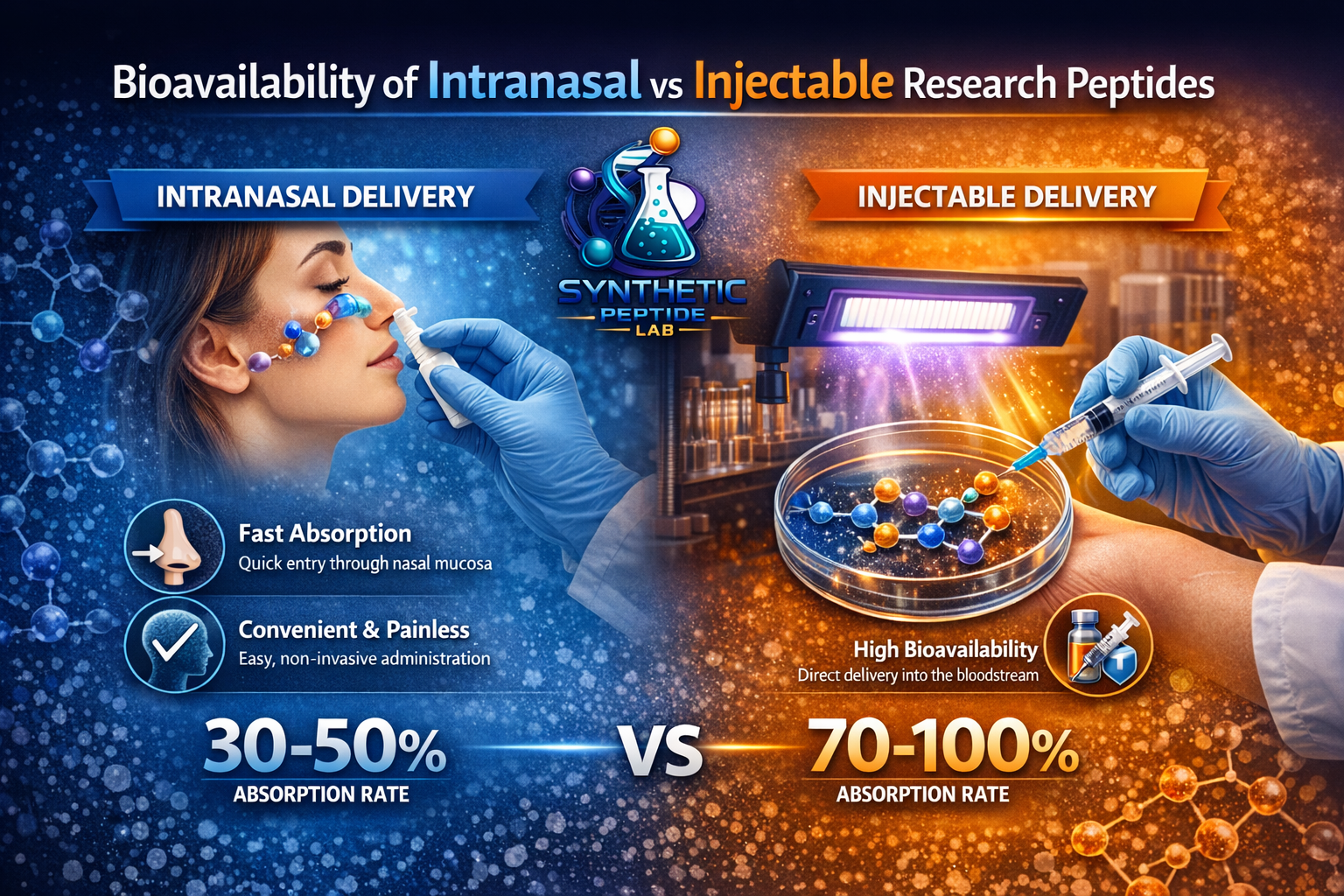
Bioavailability of Intranasal vs Injectable Research Peptides
The bioavailability of intranasal vs injectable research peptides is a key topic in pharmacokinetics and peptide delivery science. Bioavailability refers to the proportion of a compound that reaches systemic circulation in an active form and is available to produce a biological effect.
In peptide research, the route of administration plays a major role in determining absorption efficiency, onset of action, and overall experimental outcomes. In 2026 laboratory models, researchers increasingly compare intranasal and injectable delivery systems to optimize peptide performance in controlled settings.
At Synthetic Peptide Lab, we focus on providing high-purity research peptides suitable for multiple delivery method studies, supporting advanced pharmacokinetic investigations.
Understanding Bioavailability
Bioavailability is influenced by:
- Absorption rate
- Chemical stability
- Metabolic breakdown
- Transport across biological barriers
- First-pass metabolism (for systemic circulation pathways)
A higher bioavailability means more of the peptide reaches its target site in an active form.
Injectable Peptides: High Bioavailability Delivery
Overview
Injectable delivery (typically subcutaneous or intramuscular in research settings) is the most widely used method for peptide administration.
Key Features
- Direct entry into systemic circulation
- Minimal loss due to digestive or enzymatic breakdown
- Predictable absorption profile
- High and consistent bioavailability
Bioavailability Profile
Injectable peptides generally exhibit:
- Near-complete bioavailability (often considered the highest achievable in research models)
- Rapid or controlled absorption depending on formulation
- Reliable plasma concentration levels
Advantages in Research
- High precision dosing
- Reproducible pharmacokinetic data
- Strong systemic exposure
- Suitable for long-term hormone and metabolic studies
Intranasal Peptides: Non-Invasive Delivery Pathway
Overview
Intranasal delivery involves absorption through the nasal mucosa, allowing peptides to enter systemic circulation or potentially access the central nervous system via olfactory pathways.
Key Features
- Non-invasive administration route
- Rapid absorption through nasal epithelium
- Partial avoidance of gastrointestinal degradation
- Potential direct brain access in some compounds
Bioavailability Profile
Intranasal peptides typically show:
- Lower and more variable bioavailability compared to injections
- Faster onset of action in some cases
- Increased inter-individual variability in absorption
Advantages in Research
- Non-invasive administration model
- Useful for neuro-endocrine studies
- Faster initial systemic exposure
- Valuable for CNS-related peptide research
Injectable vs Intranasal: Bioavailability Comparison
| Feature | Injectable Peptides | Intranasal Peptides |
|---|---|---|
| Bioavailability | High (near complete) | Moderate to variable |
| Absorption Speed | Controlled or rapid | Very rapid onset |
| Consistency | High | Variable |
| First-pass metabolism | Avoided | Avoided |
| CNS access potential | Indirect | Possible direct pathway |
| Research reliability | Very high | Moderate |
Mechanistic Differences in Absorption
Injectable Route
Injectable peptides bypass epithelial barriers and are absorbed directly into:
- Bloodstream
- Lymphatic system (depending on formulation)
This leads to predictable pharmacokinetic curves.
Intranasal Route
Intranasal peptides absorb through:
- Nasal mucosa capillaries
- Paracellular diffusion pathways
- Possible olfactory and trigeminal nerve routes
However, absorption is influenced by:
- Mucosal integrity
- Enzymatic activity in nasal passages
- Particle size and formulation stability
Factors Affecting Bioavailability
1. Molecular Stability
Peptides prone to enzymatic degradation show reduced intranasal absorption.
2. Molecular Size
Larger peptides typically have lower nasal permeability.
3. Formulation Type
- Buffered solutions improve stability
- Delivery enhancers may increase absorption
4. Vascularization of Tissue
Injection sites provide more consistent vascular uptake compared to nasal tissue.
5. Enzymatic Environment
Nasal mucosa contains proteolytic enzymes that can degrade peptides.
Research Applications
Injectable Peptides in Research
Used for:
- Endocrine axis studies
- Metabolic pathway modeling
- Growth hormone research
- Systemic hormone regulation studies
Intranasal Peptides in Research
Used for:
- Neuro-endocrine interaction studies
- Brain-targeted peptide delivery models
- Cognitive and behavioral pathway research
- Rapid-onset pharmacokinetic experiments
CNS (Central Nervous System) Implications
Intranasal delivery is particularly interesting for:
- Potential direct brain transport pathways
- Bypassing the blood-brain barrier in some models
- Studying neuropeptide signaling dynamics
Injectable peptides, while systemic, generally rely on circulatory transport to reach the CNS indirectly.
Practical Implications in 2026 Research Models
Modern peptide research increasingly focuses on:
- Route-dependent pharmacokinetics
- Precision endocrine signaling
- Neuro-metabolic integration studies
- Optimized delivery system design
This has led to more comparative studies between nasal and injectable peptide administration.
Advantages and Limitations Summary
Injectable Peptides
Advantages:
- Highest bioavailability
- Reliable pharmacokinetics
- Strong systemic exposure
Limitations:
- Invasive administration
- Requires sterile technique
Intranasal Peptides
Advantages:
- Non-invasive
- Rapid onset
- CNS research potential
Limitations:
- Variable absorption
- Lower overall bioavailability
- Formulation sensitivity
Why Bioavailability Matters in Peptide Research
Bioavailability directly impacts:
- Dose-response accuracy
- Experimental reproducibility
- Hormonal signaling interpretation
- Data consistency across studies
Choosing the correct delivery method is essential for valid research outcomes.
Why Choose Synthetic Peptide Lab?
At Synthetic Peptide Lab, we support advanced pharmacokinetic research by providing:
- High-purity research-grade peptides
- Stable formulations for multiple delivery routes
- Reliable batch consistency
- Secure and controlled packaging
- Comprehensive research support standards
Important Notice
All compounds referenced are intended strictly for:
Research and laboratory use only.
They are not approved for human consumption or clinical use.
As we enter 2026, the discussion around peptide administration has shifted toward optimizing researcher convenience without sacrificing biological data. This report compares the bioavailability of intranasal vs injectable research peptides, focusing on absorption kinetics and mucosal delivery systems.
Injectable Delivery: The Bioavailability Gold Standard
Subcutaneous and intramuscular injections remain the benchmark for nearly 100% bioavailability. By bypassing the first-pass metabolism, injectable protocols ensure that the exact concentration of compounds like TB-500 reaches the systemic circulation. This is vital for muscle recovery research where precise dosing is mandatory.
Intranasal Delivery: The 2026 Frontier
Intranasal administration offers a non-invasive alternative, utilizing the highly vascularized nasal mucosa. While bioavailability is typically lower (ranging from 5% to 40%), this method provides a direct-to-brain pathway via the olfactory and trigeminal nerves, making it a primary focus for cognitive enhancement studies.
Conclusion
The bioavailability of intranasal vs injectable research peptides highlights a fundamental difference in peptide delivery science. Injectable routes provide the highest and most consistent systemic exposure, while intranasal delivery offers unique advantages for rapid absorption and potential central nervous system targeting.
In 2026 research models, both methods play important roles depending on experimental objectives, especially in endocrine, metabolic, and neuro-biological studies.
With high-quality compounds from Synthetic Peptide Lab, researchers can accurately explore these delivery systems and generate reliable, reproducible scientific data.