

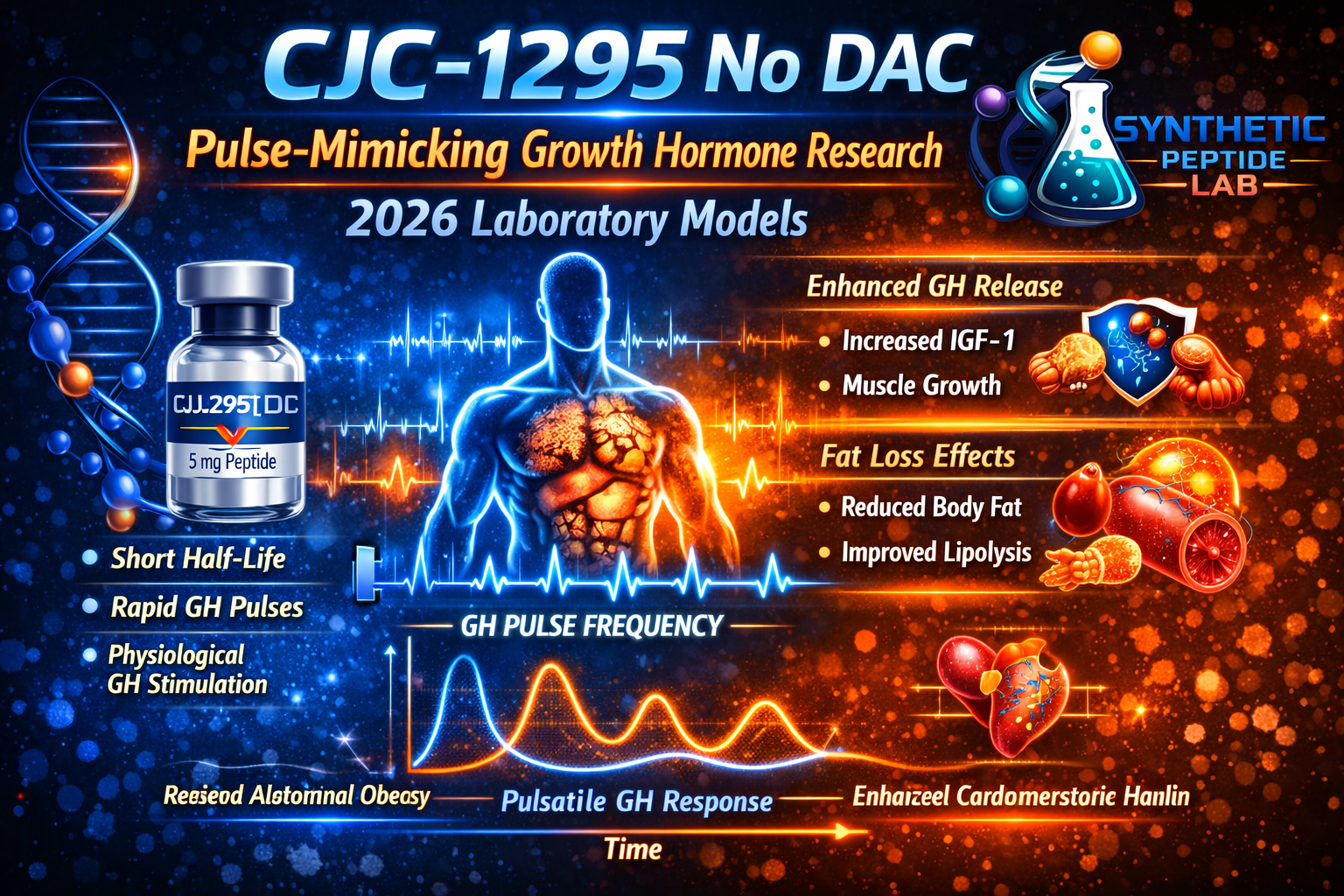
CJC-1295 No DAC: Pulse-Mimicking Growth Hormone Research in 2026 Laboratory Models
CJC-1295 No DAC has become an important compound in modern endocrine and peptide research due to its ability to stimulate growth hormone (GH) release in a pulsatile, physiologically relevant pattern. Unlike long-acting analogs, the “No DAC” (Drug Affinity Complex) version is designed for shorter activity, making it particularly valuable for researchers studying natural GH secretion rhythms in laboratory models.
At Synthetic Peptide Lab, we supply high-purity research-grade peptides such as CJC-1295 No DAC to support advanced scientific investigations into hormonal signaling and endocrine regulation.
What is CJC-1295 No DAC?
CJC-1295 No DAC is a growth hormone-releasing hormone (GHRH) analog engineered to mimic natural hypothalamic signaling without the extended half-life modification seen in DAC versions.
Key Characteristics
- Short-acting GHRH analog
- Stimulates endogenous GH secretion
- Preserves natural pulsatile hormone release
- Does not include Drug Affinity Complex (DAC) modification
This makes it particularly useful for studying physiological hormone rhythms rather than sustained elevation models.
Understanding Pulse-Mimicking Growth Hormone Release
What is Pulsatile GH Secretion?
In natural physiology, growth hormone is not released continuously. Instead, it is secreted in pulses, regulated by the hypothalamus and pituitary gland.
These pulses are important for:
- Cellular regeneration
- Metabolic regulation
- Protein synthesis signaling
- Hormonal balance maintenance
Why Pulse Mimicry Matters in Research
CJC-1295 No DAC allows researchers to replicate this natural pattern, enabling more accurate modeling of:
- Endocrine feedback loops
- GH rhythm variability
- Pituitary responsiveness
Mechanism of Action
CJC-1295 No DAC works through the growth hormone-releasing hormone (GHRH) receptor pathway.
Step-by-Step Mechanism
- Receptor Binding
The peptide binds to GHRH receptors in the anterior pituitary. - GH Secretion Activation
This triggers the release of endogenous growth hormone. - Pulsatile Response Generation
The short-acting nature leads to GH release in discrete pulses. - Downstream Signaling
GH stimulates IGF-1 production and metabolic signaling pathways.
Why the “No DAC” Form Matters
The absence of the Drug Affinity Complex significantly changes the peptide’s behavior.
Key Differences
- Shorter half-life compared to DAC version
- More natural GH pulse patterns
- Reduced prolonged receptor activation
- Better suited for time-sensitive endocrine studies
This makes CJC-1295 No DAC ideal for physiological modeling rather than sustained stimulation studies.
Research Applications in 2026 Laboratory Models
1. Endocrine Rhythm Studies
Researchers use CJC-1295 No DAC to examine:
- GH secretion timing
- Hypothalamic-pituitary feedback loops
- Hormonal pulse synchronization
2. Metabolic Regulation Research
Studies focus on:
- Energy utilization patterns
- Lipid metabolism signaling
- Glucose regulation pathways
3. Cellular Growth and Repair Models
GH pulses are associated with:
- Protein synthesis signaling
- Tissue repair pathways
- Cellular regeneration mechanisms
4. Comparative Peptide Studies
CJC-1295 No DAC is often compared with:
- Sermorelin
- Long-acting CJC-1295 (DAC)
- Ipamorelin and other secretagogues
This helps researchers understand different GH stimulation profiles.
Advantages in Research Settings
1. Physiological Accuracy
Mimics natural GH secretion more closely than long-acting analogs.
2. Temporal Control
Short action window allows precise experimental timing.
3. Reduced Hormonal Overlap
Minimizes continuous receptor stimulation, improving clarity in results.
4. Flexible Study Design
Can be combined with other GH secretagogues for comparative research.
Comparison: CJC-1295 No DAC vs CJC-1295 DAC
| Feature | No DAC | DAC Version |
|---|---|---|
| Half-life | Short | Extended |
| GH Pattern | Pulsatile | Sustained |
| Research Focus | Physiology simulation | Long-term stimulation |
| Receptor Activity | Temporary | Prolonged |
| Use Case | Rhythm studies | Continuous exposure models |
Role in Modern 2026 Research Models
In 2026, peptide research is increasingly focused on systems-level endocrine modeling. CJC-1295 No DAC plays a key role in:
- Dynamic hormone simulations
- Multi-peptide interaction studies
- AI-assisted endocrine modeling systems
- Precision metabolic research frameworks
Its pulse-mimicking nature aligns well with next-generation biological simulation approaches.
Storage and Handling
To maintain peptide integrity:
- Store in a cool, dry environment
- Refrigerate after reconstitution
- Avoid repeated freeze-thaw cycles
- Use sterile laboratory techniques
Proper handling ensures reliable and reproducible results.
Why Choose Synthetic Peptide Lab?
For CJC-1295 No DAC research, consistency is essential.
Our Advantages
- High-purity research-grade peptides
- Reliable batch consistency
- Secure packaging and shipping
- Wide selection of GH-related peptides
Synthetic Peptide Lab supports advanced endocrine research with dependable quality standards.
Important Notice
All compounds are intended strictly for:
Research and laboratory use only.
They are not approved for human consumption or clinical use.
Conclusion
CJC-1295 No DAC is a powerful tool in modern peptide research, offering a unique ability to replicate natural, pulsatile growth hormone release. Its short-acting profile makes it especially valuable for studying endocrine rhythms, metabolic signaling, and pituitary function in 2026 laboratory models.
As research continues to evolve toward more physiologically accurate simulations, CJC-1295 No DAC remains a key compound for understanding the dynamics of the growth hormone axis.
With high-quality materials from Synthetic Peptide Lab, researchers can conduct precise, reliable, and advanced studies in hormonal science.