

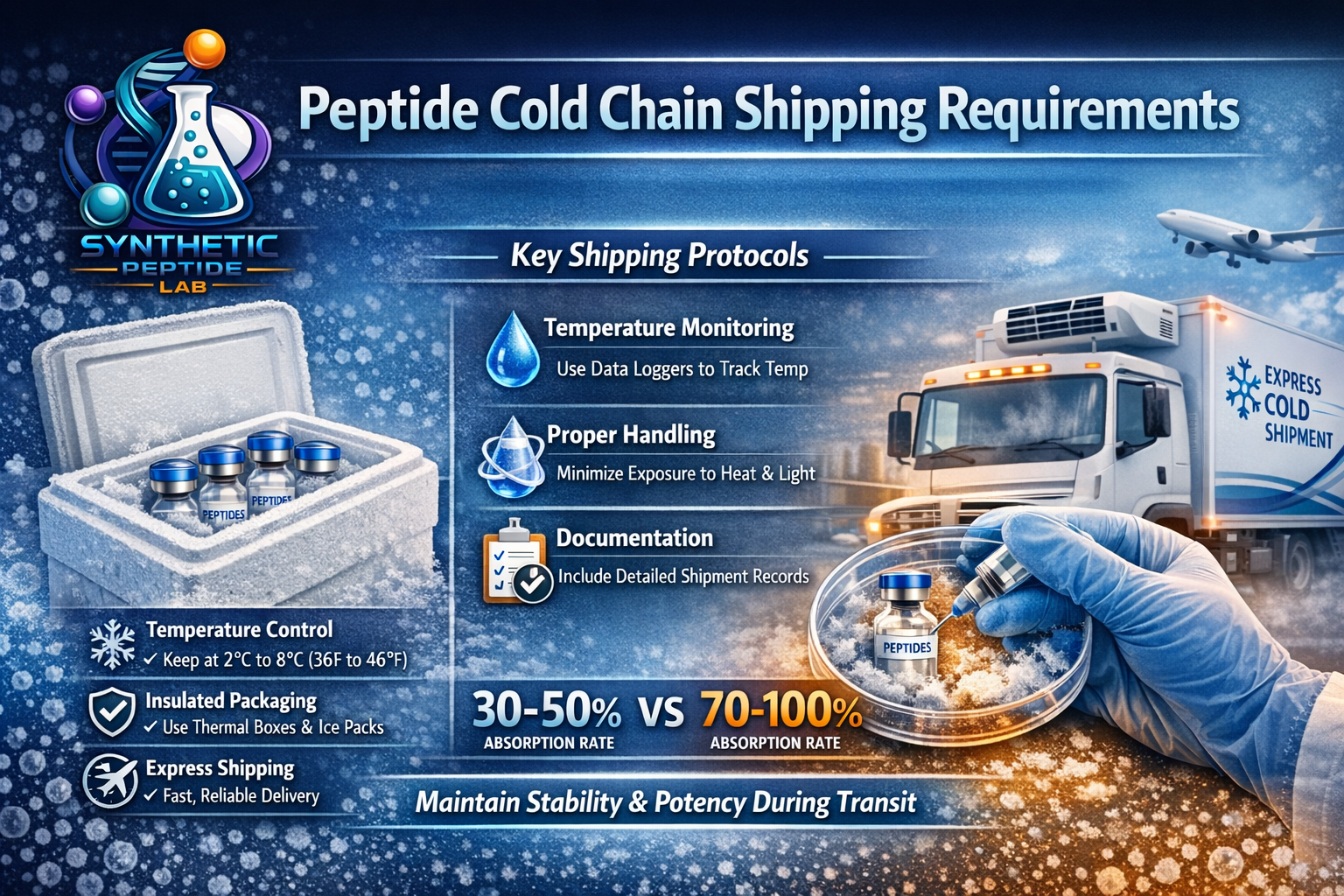
The Criticality of Thermal Regulation
In the precision-driven landscape of 2026 peptide research, the integrity of a molecular compound is often determined before it ever reaches the laboratory bench. Peptides are inherently fragile sequences of amino acids held together by peptide bonds that are susceptible to thermal degradation, oxidation, and mechanical shearing.
Understanding the Peptide Cold Chain Shipping Requirements is vital to maintain the efficacy of these compounds during transportation.
Understanding the Peptide Cold Chain Shipping Requirements is essential for researchers to ensure the quality and stability of peptide samples during transport. The Peptide Cold Chain Shipping Requirements are designed to mitigate risks associated with temperature fluctuations and handling.
At Synthetic Peptide Lab, we recognize that “Cold Chain” logistics is not merely a shipping method—it is a fundamental extension of the synthesis process. Maintaining a rigorous temperature-controlled environment from the point of final purification to the moment of delivery is essential for ensuring that research data remains accurate, reproducible, and free from the interference of degraded peptide fragments.
1. Thermal Sensitivity and Molecular Degradation
Adhering to the Peptide Cold Chain Shipping Requirements not only preserves peptide integrity but also safeguards the investment made in peptide research.
Adhering to Peptide Cold Chain Shipping Requirements ensures that peptides maintain their stability and functionality.
Peptides exist in a delicate state of structural equilibrium. When exposed to temperatures outside of their optimal range, several deleterious processes can occur:
- Hydrolysis: The chemical breakdown of a compound due to reaction with water, often accelerated by heat.
- Deamidation: A chemical reaction in which an amide functional group is removed from an amino acid (typically Glutamine or Asparagine), altering the peptide’s charge and biological activity.
- Oxidation: Specifically affecting residues like Cysteine and Methionine, oxidation can lead to the formation of disulfide bridges or sulfoxides, fundamentally changing the peptide’s folding.
- Aggregation: High temperatures can cause peptides to denature and clump together, rendering them insoluble and biologically inactive for in vitro or in vivo studies.
2. Lyophilization: The Primary Defense
The most effective way to stabilize a peptide for shipping is through Lyophilization (freeze-drying). By removing water via sublimation under a vacuum, the peptide is converted into a stable, porous solid (“cake”).
- Dry State Stability: In a lyophilized state, peptides are significantly more resistant to thermal fluctuations than they are in a liquid or reconstituted state.
- Reduced Kinetic Energy: The absence of water molecules reduces the kinetic energy available for the chemical reactions that lead to degradation.
- Shipping Advantage: While lyophilized peptides are more stable, they still require cold chain protection for long-duration transit to prevent the accumulation of “thermal stress” over time.
Incorporating the Peptide Cold Chain Shipping Requirements into your logistics processes guarantees that the peptides remain viable for experimental use upon arrival.
3. Standards for Peptide Cold Chain Logistics
Synthetic Peptide Lab adheres to strict 2026 international standards for the transport of research-grade chemicals.
Temperature Zones
| Shipping Class | Temperature Range | Application |
| Ambient | $15^{\circ}\text{C}$ to $25^{\circ}\text{C}$ | Short-duration transit for extremely stable, small-molecule peptides. |
| Refrigerated | $2^{\circ}\text{C}$ to $8^{\circ}\text{C}$ | Standard for most lyophilized research peptides. |
| Frozen | $-20^{\circ}\text{C}$ | Required for sensitive modified peptides or long-distance international shipping. |
| Ultra-Low | $-80^{\circ}\text{C}$ (Dry Ice) | Necessary for extremely unstable sequences or peptides in solution. |
Following the Peptide Cold Chain Shipping Requirements is critical for maintaining operational standards across the industry.
At Synthetic Peptide Lab, compliance with Peptide Cold Chain Shipping Requirements is a top priority, ensuring optimal delivery of sensitive materials.
4. Advanced Packaging Technologies
To maintain these temperature zones, modern cold chain shipping utilizes a “layered” protection strategy:
- Vacuum-Insulated Panels (VIPs): High-efficiency insulation that provides significantly better thermal protection than traditional polystyrene.
- Phase Change Materials (PCMs): Specialized gel packs or bricks that maintain a specific temperature (e.g., $4^{\circ}\text{C}$) for 72–96 hours regardless of external conditions.
- Real-Time Data Loggers: Small electronic devices included in the package that record temperature and humidity every minute. Upon arrival, researchers at Synthetic Peptide Lab can verify that the “chain” was never broken.
Investing in technology to meet Peptide Cold Chain Shipping Requirements can enhance the reliability of peptide distribution networks.
5. Handling Upon Arrival: The “Thermal Equilibrium” Rule
A common mistake in peptide research is opening a cold-shipped vial immediately upon arrival. This can lead to atmospheric moisture condensation inside the vial, which introduces water to the lyophilized powder and triggers degradation.
The Synthetic Peptide Lab Protocol:
- Step 1: Retrieve the package and check the data logger for temperature excursions.
- Step 2: Place the sealed vials in a desiccator.
- Step 3: Allow the vials to reach room temperature ($20^{\circ}\text{C}$ to $25^{\circ}\text{C}$) while still sealed and desiccated.
- Step 4: Only once equilibrium is reached should the vial be opened for reconstitution or long-term storage at $-20^{\circ}\text{C}$.
6. International Shipping and Regulatory Complexity
Shipping peptides globally in 2026 involves navigating customs for “Research Use Only” (RUO) compounds.
- Customs Delays: Any delay at a border can be fatal for a cold chain package.
- Proactive Logistics: We utilize “white-glove” couriers who specialize in life sciences, ensuring packages are “topped up” with dry ice or kept in refrigerated holding cells during customs inspections.
7. Impact of Broken Cold Chains on Research Data
If a peptide is exposed to high heat (e.g., a package sitting on a tarmac in summer), the resulting impurities (truncated sequences or oxidized fragments) may not be visible to the naked eye but will be evident in HPLC and Mass Spec analysis.
- Using degraded peptides leads to non-reproducible results.
- It can cause unexpected cellular toxicity in in vitro assays.
- It lowers the effective concentration, leading to under-dosed experiments.
Understanding the nuances of Peptide Cold Chain Shipping Requirements facilitates better decision-making in laboratory environments.
Conclusion: Precision Logistics for Precision Science
At Synthetic Peptide Lab, we believe that the quality of your research is only as good as the logistics that delivered your compounds. By enforcing a “Zero-Excursion” cold chain policy, we ensure that every 39-amino acid sequence or complex GGG-agonist reaches your facility in the exact state it left our laboratory.
Research Notice: All peptides provided by Synthetic Peptide Lab are strictly for laboratory research purposes only. Proper storage and cold chain maintenance are required to preserve the analytical integrity of these compounds.
Our commitment to the Peptide Cold Chain Shipping Requirements ensures that each product arrives in peak condition, ready for immediate use in research.
3 thoughts on “Peptide Cold Chain Shipping Requirements”