

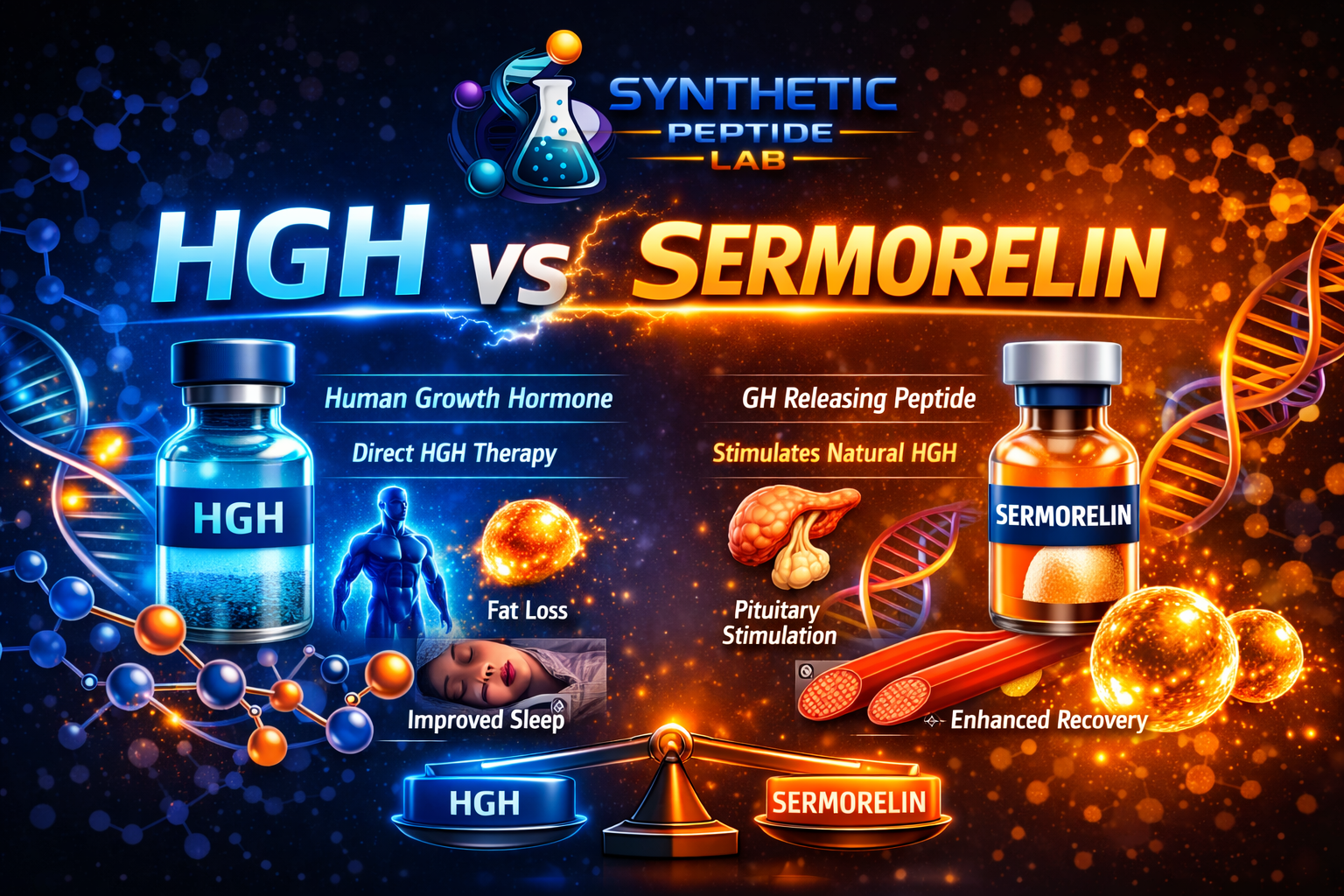
HGH vs Sermorelin: Pituitary Stimulation vs Direct Replacement
Introduction
The comparison between HGH (Human Growth Hormone) and Sermorelin is one of the most discussed topics in endocrine and peptide research. Both compounds are associated with the growth hormone axis, but they function in fundamentally different ways. Understanding the distinction between direct hormone replacement and pituitary stimulation is essential for researchers studying hormonal regulation, feedback mechanisms, and metabolic pathways.
At Synthetic Peptide Lab, we provide high-purity research peptides to support advanced scientific investigations into compounds such as HGH and Sermorelin.
What is HGH (Human Growth Hormone)?
HGH, also known as somatotropin, is a peptide hormone naturally produced by the pituitary gland. In research settings, synthetic HGH is used as a direct replacement for endogenous growth hormone.
Key Characteristics of HGH
- Acts directly in the body as growth hormone
- Does not require pituitary stimulation
- Bypasses natural regulatory mechanisms
- Provides immediate elevation of GH levels in experimental models
Research Focus Areas
- Hormone replacement models
- Growth factor signaling pathways
- Protein synthesis and cellular growth
- Metabolic function studies
HGH is often used in studies where controlled and immediate GH presence is required.
What is Sermorelin?
Sermorelin is a synthetic peptide classified as a growth hormone-releasing hormone (GHRH) analog. Instead of supplying GH directly, it stimulates the pituitary gland to naturally produce and release growth hormone.
Key Characteristics of Sermorelin
- Stimulates endogenous GH production
- Works through the hypothalamic-pituitary axis
- Maintains natural hormone feedback loops
- Produces pulsatile GH release patterns
Research Focus Areas
- Pituitary function studies
- Hormonal feedback mechanisms
- GH secretion patterns
- Endocrine system regulation
Sermorelin is widely used in research exploring natural hormone regulation processes.
Core Difference: Direct Replacement vs Pituitary Stimulation
The primary distinction between HGH and Sermorelin lies in how they influence growth hormone levels.
HGH – Direct Replacement
- Introduces GH directly into the system
- Bypasses pituitary signaling
- Provides consistent and immediate hormone levels
- Does not rely on natural secretion mechanisms
Sermorelin – Pituitary Stimulation
- Activates the pituitary gland
- Encourages natural GH production
- Preserves biological rhythms and feedback loops
- Produces more physiologically aligned hormone release
This difference is critical when designing experiments involving hormonal balance and endocrine system behavior.
Mechanism of Action Comparison
HGH Mechanism
- Directly binds to GH receptors
- Triggers downstream signaling pathways
- Influences IGF-1 production in research models
Sermorelin Mechanism
- Binds to GHRH receptors in the pituitary
- Stimulates GH secretion in pulses
- Activates natural endocrine signaling cascades
Research Applications
HGH Research Applications
- Direct hormone replacement models
- Cellular growth and regeneration studies
- Metabolic and protein synthesis research
- Controlled GH exposure experiments
Sermorelin Research Applications
- Pituitary gland function analysis
- Hormone pulsatility studies
- Endocrine feedback loop research
- Natural GH regulation models
Advantages in Research Context
HGH
- Precise control over GH levels
- Immediate biological availability
- Useful for direct pathway analysis
Sermorelin
- Mimics natural GH release patterns
- Supports long-term endocrine studies
- Preserves physiological regulation mechanisms
Key Differences Summary
| Feature | HGH | Sermorelin |
|---|---|---|
| Type | Direct hormone | GHRH analog |
| Function | Replacement | Stimulation |
| Pituitary Involvement | No | Yes |
| GH Release Pattern | Continuous | Pulsatile |
| Feedback Mechanisms | Bypassed | Maintained |
| Research Focus | Direct GH effects | Endocrine regulation |
Choosing Between HGH and Sermorelin in Research
The choice depends on the research objective:
- Use HGH when studying direct hormone effects and controlled GH exposure
- Use Sermorelin when investigating natural hormone production and regulation
Many researchers explore both compounds to compare artificial vs physiological hormone dynamics.
Why Source from Synthetic Peptide Lab?
When working with HGH or Sermorelin, quality and consistency are essential.
Our Advantages
- High-purity research-grade peptides
- Reliable batch consistency
- Secure packaging and storage
- Wide selection of endocrine-related peptides
Synthetic Peptide Lab supports researchers with compounds designed for precision and reproducibility.
Storage and Handling
To maintain peptide stability:
- Store in a cool, dry environment
- Refrigerate after reconstitution
- Avoid repeated freeze-thaw cycles
- Use sterile laboratory techniques
Proper handling ensures optimal research results.
Important Notice
All products mentioned are intended strictly for:
Research and laboratory use only.
They are not approved for human consumption or medical use.
Understanding the difference between HGH (Human Growth Hormone) and its secretagogues like Sermorelin is fundamental for endocrine research. This 2026 comparison focuses on pituitary fatigue and natural GH pulsatility.
Direct Replacement vs. Pituitary Stimulation
While HGH provides an immediate exogenous increase in hormone levels, Sermorelin stimulates the pituitary gland to produce its own GH. This natural approach preserves the negative feedback loop, making it a preferred subject for long-term longevity studies. For high-purity samples, see our verified purity standards.
Conclusion
The comparison of HGH vs Sermorelin highlights a fundamental concept in peptide research: direct hormone replacement versus natural stimulation of the endocrine system.
HGH provides immediate and controlled hormone levels, while Sermorelin supports the body’s natural regulatory processes through pituitary activation. Each approach offers unique advantages depending on the research objective.
With high-quality compounds from Synthetic Peptide Lab, researchers can explore these pathways with confidence, advancing the understanding of growth hormone biology and endocrine function.