

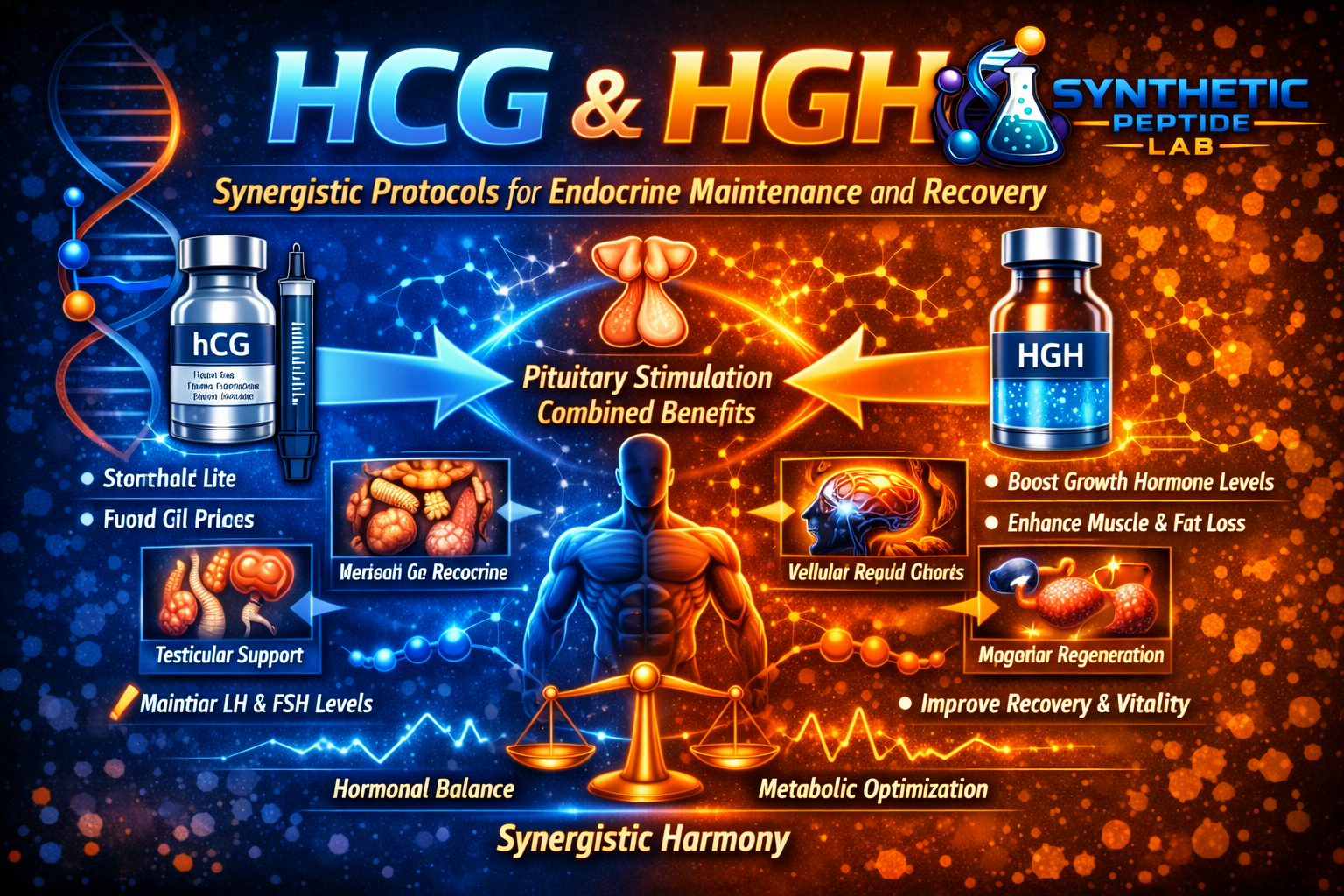
HCG and HGH | Understanding Two Key Hormonal Compounds in Research
HCG (Human Chorionic Gonadotropin) and HGH (Human Growth Hormone) are two distinct but widely studied compounds in endocrine and metabolic research. While both are involved in hormonal regulation, they operate through completely different biological systems and serve different roles in scientific investigations.
At Synthetic Peptide Lab, we provide high-purity research-grade peptides for laboratory use, supporting advanced studies into hormone signaling, metabolism, and endocrine system function.
What is HCG?
Overview
Human Chorionic Gonadotropin (HCG) is a glycoprotein hormone that mimics the action of luteinizing hormone (LH). In research models, it is used to study reproductive and endocrine signaling pathways.
Key Functions in Research
- Stimulates LH receptors
- Influences gonadal hormone production
- Used in reproductive system studies
- Helps analyze endocrine feedback loops
Research Focus Areas
- Testicular and ovarian function models
- Hormonal regulation pathways
- Reproductive endocrinology
- Feedback mechanisms in the hypothalamic-pituitary axis
What is HGH?
Overview
Human Growth Hormone (HGH) is a peptide hormone produced by the pituitary gland and is essential for growth, metabolism, and cellular regeneration studies.
Key Functions in Research
- Stimulates growth and repair pathways
- Influences protein synthesis
- Regulates metabolic processes
- Supports IGF-1 production in research models
Research Focus Areas
- Growth and development studies
- Metabolic regulation research
- Cellular regeneration pathways
- Endocrine system signaling
Core Differences Between HCG and HGH
Although both are hormones, HCG and HGH operate in completely different biological systems.
| Feature | HCG | HGH |
|---|---|---|
| Type | Glycoprotein hormone | Peptide hormone |
| Primary System | Reproductive axis | Growth/metabolic axis |
| Main Function | LH mimicry | Growth and metabolism regulation |
| Target Organs | Gonads | Liver, muscle, tissue systems |
| Research Focus | Fertility & endocrine signaling | Growth, repair, metabolism |
Mechanism of Action
HCG Mechanism
HCG binds to LH receptors, triggering:
- Gonadal hormone production
- Reproductive signaling cascades
- Endocrine feedback responses
HGH Mechanism
HGH acts directly on growth hormone receptors, leading to:
- Activation of IGF-1 pathways
- Increased protein synthesis
- Cellular growth and repair signaling
Combined Interest in Research
Although HCG and HGH function independently, researchers often study them together to explore:
- Hormonal axis interactions
- Endocrine system balance
- Multi-hormone regulatory models
- Cross-system signaling effects
This helps provide a more complete understanding of human endocrine function.
Applications in Scientific Research
HCG Applications
- Reproductive endocrinology studies
- Hormonal stimulation models
- Gonadal function research
- LH receptor interaction analysis
HGH Applications
- Growth and development studies
- Metabolic pathway research
- Cellular regeneration models
- Protein synthesis investigations
Endocrine System Interaction
The endocrine system is highly interconnected. While HCG primarily influences the reproductive axis, HGH operates within the growth and metabolic axis.
Researchers study these systems to understand:
- Hormonal feedback loops
- Cross-axis communication
- System-wide metabolic regulation
Advantages in Research Models
HCG Advantages
- Strong receptor specificity (LH receptors)
- Useful for reproductive system modeling
- Clear endocrine feedback analysis
HGH Advantages
- Broad metabolic influence
- Useful for growth and tissue studies
- Central role in endocrine signaling networks
Storage and Handling
To maintain peptide integrity in research settings:
- Store in a cool, dry environment
- Refrigerate after reconstitution
- Avoid repeated freeze-thaw cycles
- Use sterile laboratory techniques
Proper handling ensures accurate and reproducible results.
Why Choose Synthetic Peptide Lab?
When studying HCG and HGH, quality and consistency are essential.
Our Advantages
- High-purity research-grade peptides
- Reliable batch consistency
- Secure packaging and delivery
- Wide range of endocrine research compounds
Synthetic Peptide Lab supports advanced scientific research with dependable materials.
Important Notice
All compounds are intended strictly for:
Research and laboratory use only.
They are not approved for human consumption or medical use.
Conclusion
HCG and HGH are two fundamentally different hormones that play important roles in endocrine research. HCG primarily influences reproductive hormone pathways, while HGH regulates growth, metabolism, and cellular function.
Understanding both compounds allows researchers to explore how different hormonal systems interact within the broader endocrine network.
With high-quality peptides from Synthetic Peptide Lab, scientists can conduct precise and reliable studies, advancing knowledge in hormone biology and metabolic research.