

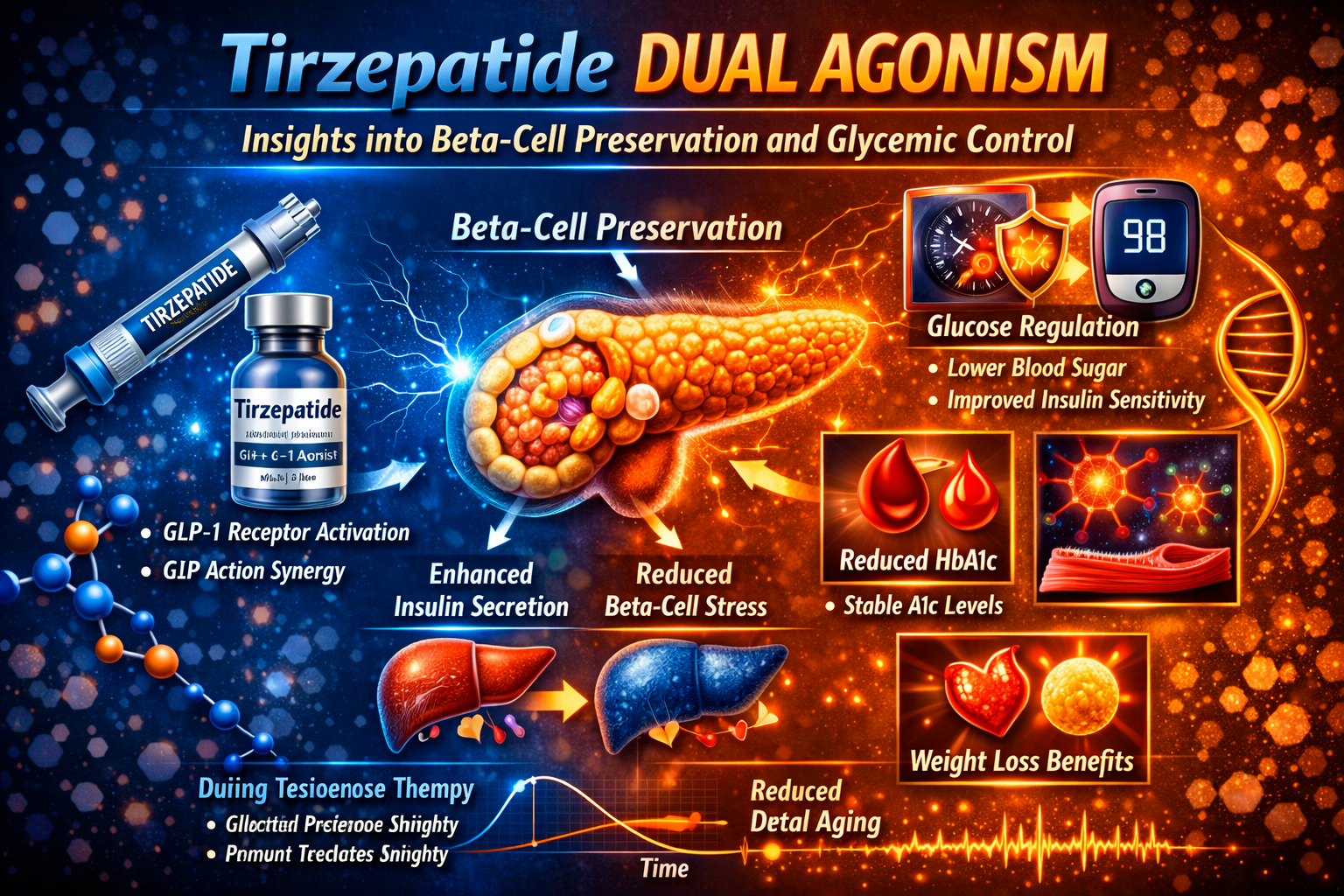
Tirzepatide Dual Agonism: Insights into Beta-Cell Preservation and Glycemic Control
Introduction
The emergence of Tirzepatide dual agonism has marked a significant advancement in metabolic peptide research. By targeting both GLP-1 (glucagon-like peptide-1) and GIP (glucose-dependent insulinotropic polypeptide) receptors, Tirzepatide offers a unique framework for studying beta-cell function, insulin dynamics, and glycemic control in laboratory models.
At Synthetic Peptide Lab, we provide high-purity Tirzepatide for research applications, supporting scientists investigating complex endocrine and metabolic pathways.
Understanding Dual Agonism
What is Dual Agonism?
Dual agonism refers to a compound’s ability to activate two distinct receptor pathways simultaneously. In the case of Tirzepatide:
- GLP-1 receptor activation influences insulin secretion and appetite signaling
- GIP receptor activation enhances insulin response and modulates metabolic efficiency
This combined mechanism allows researchers to explore synergistic hormonal effects not achievable with single-pathway peptides.
Mechanism of Action
GLP-1 Pathway
Tirzepatide stimulates GLP-1 receptors, leading to:
- Increased insulin secretion in response to glucose
- Regulation of gastric emptying in experimental models
- Modulation of appetite-related signaling
GIP Pathway
Activation of GIP receptors contributes to:
- Enhanced insulin sensitivity
- Support of beta-cell responsiveness
- Improved glucose-dependent signaling
Combined Effect
The interaction between GLP-1 and GIP pathways results in:
- Amplified insulinotropic effects
- Coordinated metabolic signaling
- More efficient glucose regulation in research settings
Beta-Cell Preservation in Research Models
Role of Beta Cells
Beta cells, located in the pancreatic islets, are responsible for producing insulin. Their function and survival are critical in maintaining glucose balance.
Tirzepatide’s Research Relevance
Studies involving Tirzepatide explore its potential to:
- Support beta-cell function under metabolic stress
- Reduce cellular strain associated with prolonged glucose exposure
- Enhance insulin secretion efficiency
- Influence cellular signaling pathways linked to survival
Mechanistic Insights
Dual receptor activation may:
- Reduce beta-cell workload through improved insulin sensitivity
- Promote adaptive cellular responses
- Support long-term functionality in experimental models
Glycemic Control and Metabolic Regulation
Glucose Homeostasis
Tirzepatide is widely studied for its effects on:
- Blood glucose regulation
- Insulin-glucose dynamics
- Hormonal coordination in metabolic systems
Key Research Observations
- Improved glucose-dependent insulin response
- Reduced fluctuations in glucose levels in controlled models
- Enhanced metabolic signaling efficiency
Integrated Hormonal Effects
The dual agonist mechanism enables researchers to study:
- Cross-talk between incretin pathways
- Coordinated endocrine responses
- System-wide metabolic balance
Advantages of Tirzepatide in Research
1. Multi-Pathway Activation
Simultaneous engagement of GLP-1 and GIP receptors allows for deeper exploration of metabolic systems.
2. Enhanced Stability
Engineered for prolonged activity, enabling extended observation periods.
3. Reduced Variability
More consistent outcomes in controlled experimental conditions.
4. Advanced Metabolic Modeling
Supports complex research designs involving multiple hormonal pathways.
Comparison with Other Metabolic Peptides
| Feature | Semaglutide | Tirzepatide | Retatrutide |
|---|---|---|---|
| Receptor Targets | GLP-1 | GLP-1 + GIP | GLP-1 + GIP + Glucagon |
| Mechanism Type | Single agonist | Dual agonist | Triple agonist |
| Beta-Cell Focus | Moderate | Strong | Emerging |
| Glycemic Control | Effective | Enhanced | Advanced |
Tirzepatide represents a bridge between single and multi-receptor peptide strategies, offering a balanced level of complexity and control.
Applications in Scientific Research
Endocrine Studies
- Hormonal signaling pathways
- Insulin secretion mechanisms
- Receptor interaction analysis
Metabolic Research
- Glucose regulation models
- Energy balance studies
- Insulin sensitivity exploration
Cellular Biology
- Beta-cell function analysis
- Signal transduction pathways
- Cellular adaptation mechanisms
Factors Influencing Research Outcomes
- Peptide purity and formulation
- Experimental design and model selection
- Dosage and exposure duration
- Storage and handling conditions
Careful control of these variables is essential for reliable results.
Storage and Handling
To maintain peptide integrity:
- Store in a cool, dry environment
- Refrigerate after reconstitution
- Avoid repeated freeze-thaw cycles
- Use sterile laboratory techniques
Why Choose Synthetic Peptide Lab?
When studying Tirzepatide, quality is critical.
Our Advantages
- High-purity research-grade Tirzepatide
- Consistent batch quality
- Secure packaging and delivery
- Reliable supply for ongoing research
Synthetic Peptide Lab supports advanced peptide research with dependable solutions.
The 2026 research landscape for Tirzepatide has shifted toward long-term metabolic stability. This report analyzes the dual-agonist approach (GLP-1 + GIP) and its superiority in maintaining glycemic control in animal models.
Dual Agonism and Beta-Cell Health
Tirzepatide’s dual action provides a more comprehensive metabolic response than GLP-1 mono-agonists. Recent studies focus on its potential to preserve pancreatic beta-cell function over extended research periods. Researchers can order Tirzepatide to explore these advanced glycemic regulation pathways.
Important Notice
All compounds are intended strictly for:
Research and laboratory use only.
They are not approved for human consumption or medical use.
Conclusion
Tirzepatide dual agonism represents a major advancement in metabolic peptide research, offering valuable insights into beta-cell preservation and glycemic control. By simultaneously targeting GLP-1 and GIP receptors, Tirzepatide enables researchers to explore complex hormonal interactions and metabolic regulation with greater precision.
Its ability to support beta-cell function and enhance glucose regulation in laboratory models makes it a powerful tool in modern endocrine research.
With high-quality compounds from Synthetic Peptide Lab, researchers can confidently investigate these advanced mechanisms and contribute to the evolving landscape of metabolic science.