

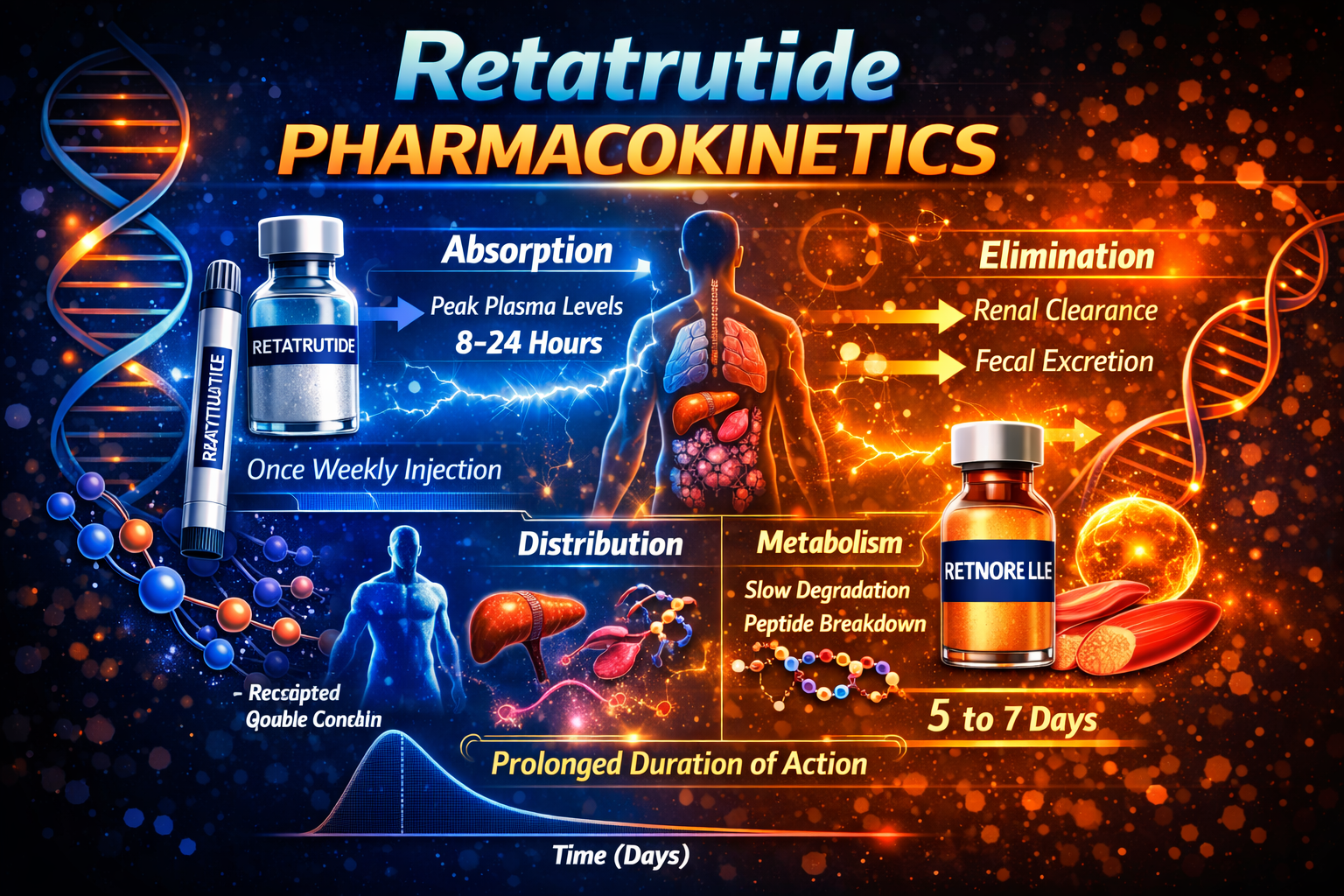
Retatrutide Pharmacokinetics | Advanced Research Overview
Introduction
Retatrutide pharmacokinetics has become a major focus in modern metabolic peptide research due to the compound’s unique triple agonist profile. Designed to interact with GLP-1, GIP, and glucagon receptors, Retatrutide represents a new generation of peptides that require deeper investigation into how they are absorbed, distributed, metabolized, and eliminated in research models.
At Synthetic Peptide Lab, we support scientific exploration by providing high-purity research peptides, including Retatrutide, to help researchers better understand complex pharmacokinetic behaviors.
What is Retatrutide?
Retatrutide is a synthetic peptide engineered to act as a triple receptor agonist, targeting:
- GLP-1 (glucagon-like peptide-1) receptors
- GIP (glucose-dependent insulinotropic polypeptide) receptors
- Glucagon receptors
This multi-pathway interaction makes its pharmacokinetic profile more complex compared to single or dual agonist peptides.
Overview of Pharmacokinetics
Pharmacokinetics (PK) refers to how a compound moves through a biological system. For Retatrutide, this includes four key phases:
- Absorption
- Distribution
- Metabolism
- Elimination
Understanding these phases helps researchers evaluate peptide stability, duration of action, and biological interaction patterns.
Absorption of Retatrutide
In research settings, peptide compounds like Retatrutide are often studied using controlled administration methods.
Key Absorption Characteristics
- Designed for gradual and sustained absorption
- Modified peptide structure enhances stability
- Slower absorption compared to short-acting peptides
This extended absorption phase allows researchers to observe prolonged receptor engagement across multiple pathways.
Distribution in Biological Systems
Once absorbed, Retatrutide is distributed throughout the system where it interacts with target receptors.
Distribution Features
- Circulates in the bloodstream with peptide-binding interactions
- Reaches tissues expressing GLP-1, GIP, and glucagon receptors
- Supports multi-organ research models
Distribution patterns are essential for understanding how the peptide influences system-wide metabolic processes.
Metabolism of Retatrutide
Peptides are typically metabolized through enzymatic degradation.
Key Metabolic Aspects
- Proteolytic enzymes gradually break down the peptide
- Structural modifications increase resistance to rapid degradation
- Extended metabolic stability compared to earlier peptides
This slower metabolism contributes to a longer duration of activity in research environments.
Elimination and Half-Life
Elimination refers to how the compound is cleared from the system.
Retatrutide Elimination Characteristics
- Extended half-life compared to single-pathway peptides
- Gradual clearance supports long-duration studies
- Reduced frequency of administration in experimental models
A longer half-life is one of the defining features that differentiates Retatrutide from earlier metabolic peptides.
Pharmacokinetic Advantages of Retatrutide
1. Prolonged Activity
The extended half-life allows sustained receptor activation across multiple pathways.
2. Multi-Pathway Engagement
Simultaneous interaction with three receptor systems enhances research complexity.
3. Improved Stability
Structural modifications protect against rapid enzymatic breakdown.
4. Reduced Variability
More stable PK profiles contribute to consistent experimental outcomes.
Comparison with Other Metabolic Peptides
| Feature | Semaglutide | Tirzepatide | Retatrutide |
|---|---|---|---|
| Receptor Targets | GLP-1 | GLP-1 + GIP | GLP-1 + GIP + Glucagon |
| PK Complexity | Moderate | Advanced | Highly Advanced |
| Half-Life | Long | Long | Extended |
| Stability | High | High | Very High |
Retatrutide stands out due to its enhanced pharmacokinetic stability and multi-receptor targeting.
Research Applications
Metabolic Studies
- Energy balance research
- Glucose metabolism pathways
- Hormonal interaction models
Endocrine Research
- Multi-hormone signaling analysis
- Receptor interaction studies
- Feedback mechanism exploration
Pharmacological Modeling
- Long-acting peptide behavior
- Dose-response relationships
- Multi-pathway pharmacokinetics
Factors Influencing Pharmacokinetics
Several variables can affect Retatrutide’s PK profile in research:
- Peptide formulation and purity
- Storage and handling conditions
- Experimental model design
- Administration method
Controlling these factors is essential for accurate and reproducible results.
Storage and Handling Considerations
To maintain pharmacokinetic integrity:
- Store in a cool, dry environment
- Refrigerate after reconstitution
- Avoid repeated freeze-thaw cycles
- Use sterile laboratory practices
Proper handling ensures consistent PK behavior during studies.
Why Choose Synthetic Peptide Lab?
When studying Retatrutide pharmacokinetics, sourcing high-quality peptides is critical.
Our Advantages
- High-purity research-grade Retatrutide
- Consistent batch production
- Secure packaging and transport
- Reliable supply for ongoing research
Synthetic Peptide Lab is committed to supporting advanced peptide research with dependable products.
Important Notice
All compounds are intended strictly for:
Research and laboratory use only.
They are not approved for human consumption or medical application.
As metabolic research advances into 2026, the focus has shifted toward the pharmacokinetics of Retatrutide. As a triple agonist targeting GLP-1, GIP, and Glucagon receptors, it represents the most significant leap in research since the introduction of Tirzepatide.
Triple Agonism: The New Research Standard
Retatrutide’s unique ability to stimulate the glucagon receptor alongside incretin mimetics allows for increased energy expenditure in laboratory models. This makes it a primary subject for studies involving non-alcoholic fatty liver disease (NAFLD) and advanced metabolic syndrome. Researchers looking to order Retatrutide should focus on its dose-dependent effects on lipid metabolism.
Conclusion
Retatrutide pharmacokinetics represents a significant advancement in peptide science, combining extended half-life, enhanced stability, and multi-receptor targeting into a single compound. Its complex PK profile provides researchers with a powerful tool for studying integrated metabolic systems.
As peptide research continues to evolve, Retatrutide stands at the forefront, offering new opportunities to explore the interactions between hormonal pathways and metabolic regulation.
With high-quality compounds from Synthetic Peptide Lab, researchers can confidently investigate these advanced pharmacokinetic properties and contribute to the future of metabolic science.