

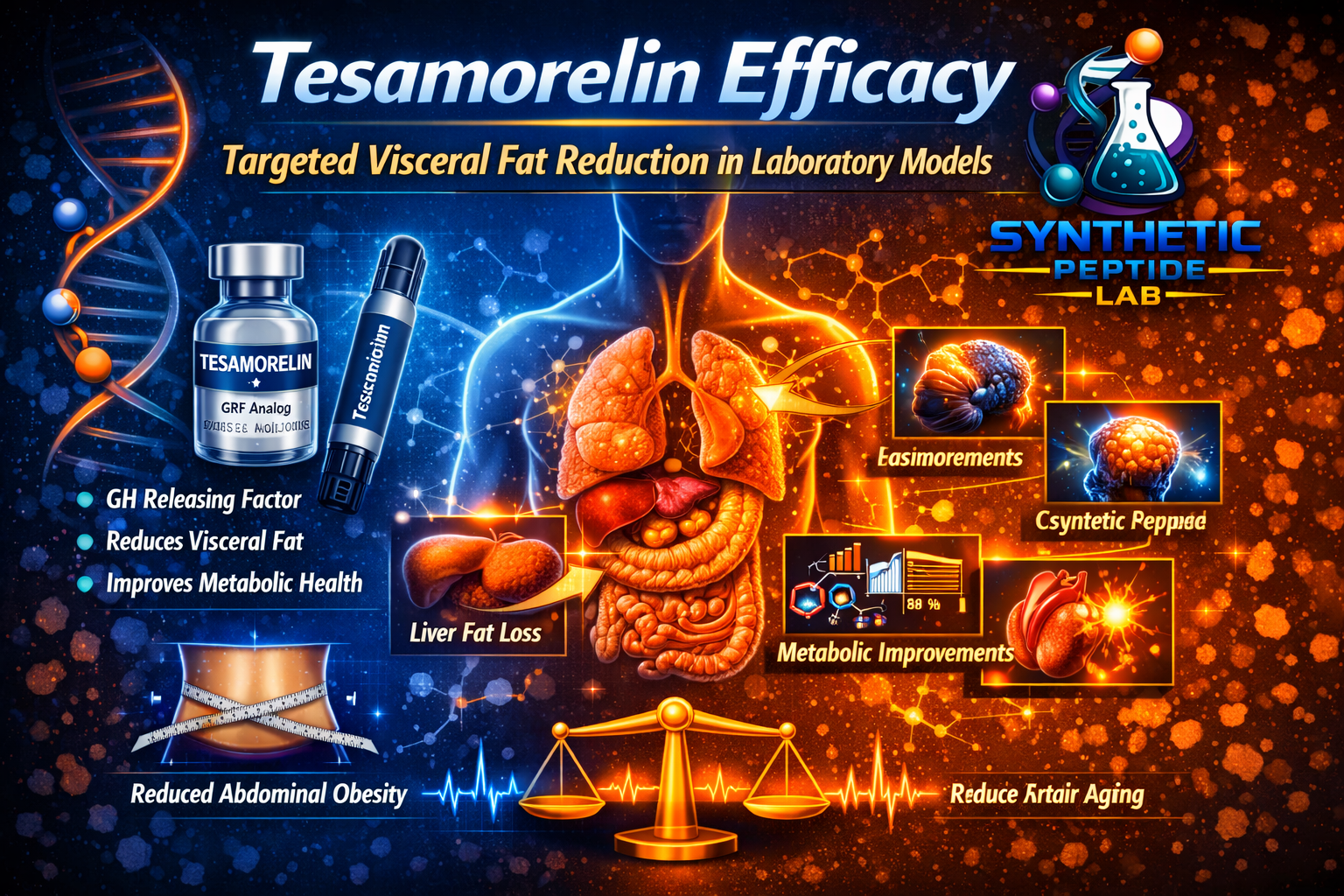
Tesamorelin Efficacy: Targeted Visceral Fat Reduction in Laboratory Models
Introduction
The study of Tesamorelin efficacy has become increasingly important in metabolic and endocrine research, particularly in relation to targeted visceral fat reduction. As a synthetic analog of growth hormone–releasing hormone (GHRH), Tesamorelin is designed to stimulate endogenous growth hormone (GH) production, making it a valuable compound for investigating how hormonal pathways influence fat distribution and metabolic regulation.
At Synthetic Peptide Lab, we provide high-purity Tesamorelin for research applications, supporting detailed exploration of its mechanisms and effects in controlled laboratory environments.
What is Tesamorelin?
Tesamorelin is a modified GHRH analog engineered to enhance stability and extend activity compared to native GHRH.
Key Characteristics
- Stimulates the pituitary gland to release growth hormone
- Promotes downstream production of insulin-like growth factor-1 (IGF-1)
- Designed for improved resistance to enzymatic degradation
- Supports sustained hormonal signaling in research models
Tesamorelin is widely studied for its role in metabolic regulation and fat distribution.
Understanding Visceral Fat in Research
What is Visceral Fat?
Visceral fat is adipose tissue stored around internal organs, distinct from subcutaneous fat located beneath the skin.
Why It Matters in Research
- Associated with metabolic activity
- Influences hormonal signaling
- Plays a role in energy balance
- Linked to systemic physiological processes
Studying visceral fat provides insight into complex metabolic pathways and endocrine interactions.
Mechanism of Action: How Tesamorelin Works
Tesamorelin exerts its effects through the growth hormone axis.
Step-by-Step Mechanism
- Pituitary Stimulation
Tesamorelin binds to GHRH receptors in the pituitary gland. - Growth Hormone Release
The pituitary increases secretion of endogenous GH. - IGF-1 Production
GH stimulates IGF-1 synthesis, primarily in the liver. - Metabolic Effects
IGF-1 and GH influence lipid metabolism and fat distribution.
This cascade is central to understanding targeted fat reduction mechanisms in laboratory models.
Tesamorelin and Visceral Fat Reduction
Targeted Fat Reduction in Research Models
Studies involving Tesamorelin focus on how GH-mediated pathways influence:
- Lipolysis (breakdown of fat)
- Fat redistribution
- Energy utilization
- Hormonal regulation of adipose tissue
Why Visceral Fat is Specifically Affected
Visceral fat is more metabolically active than subcutaneous fat, making it more responsive to hormonal signals such as GH and IGF-1.
Research Findings and Observations
In controlled laboratory settings, Tesamorelin has been associated with:
- Reduction in visceral adipose tissue markers
- Changes in lipid metabolism pathways
- Enhanced GH pulsatility
- Increased IGF-1 levels in experimental models
These findings highlight its relevance in metabolic and endocrine research.
Applications in Scientific Research
Metabolic Studies
- Fat metabolism analysis
- Energy balance research
- Hormonal regulation of adipose tissue
Endocrine Research
- GH axis investigation
- Pituitary function studies
- Hormone signaling pathways
Cellular Research
- Lipid metabolism at the cellular level
- Signal transduction mechanisms
- Gene expression related to fat regulation
Advantages of Tesamorelin in Research
- Mimics natural GH release patterns
- Targets metabolic pathways linked to fat distribution
- Provides sustained activity due to enhanced stability
- Supports long-term experimental designs
Comparison with Other GH-Related Peptides
| Feature | Tesamorelin | Sermorelin | CJC-1295 |
|---|---|---|---|
| Type | GHRH analog | GHRH analog | GHRH analog (modified) |
| Stability | High | Moderate | Very High |
| Focus | Visceral fat research | GH stimulation | Long-acting GH release |
| Research Complexity | Advanced | Moderate | Advanced |
Tesamorelin is particularly noted for its targeted metabolic research applications.
Factors Influencing Efficacy in Research
- Peptide purity and formulation
- Experimental model design
- Dosage and administration frequency
- Duration of exposure
- Storage and handling conditions
Careful control of these variables is essential for reproducible results.
Storage and Handling
To maintain peptide integrity:
- Store in a cool, dry environment
- Refrigerate after reconstitution
- Avoid repeated freeze-thaw cycles
- Use sterile laboratory techniques
Why Choose Synthetic Peptide Lab?
For Tesamorelin research, quality and consistency are critical.
Our Advantages
- High-purity research-grade Tesamorelin
- Reliable batch consistency
- Secure packaging and delivery
- Comprehensive peptide catalog
Synthetic Peptide Lab supports researchers with dependable and high-quality compounds.
In the realm of body composition research, Tesamorelin stands out for its specificity. This 2026 technical report examines its efficacy in reducing visceral adipose tissue (VAT) compared to broad-spectrum growth hormone secretagogues.
Visceral Adipose Tissue Targeting
Unlike HGH, which has systemic effects, Tesamorelin specifically targets the reduction of “hard” belly fat. This makes it an invaluable tool for researchers studying lipodystrophy and cardiovascular risk factors. Its stability profile is enhanced when following our 2026 storage protocols.
Important Notice
All compounds are intended strictly for:
Research and laboratory use only.
They are not approved for human consumption or clinical use.
Conclusion
Tesamorelin efficacy in targeted visceral fat reduction represents a significant area of interest in modern metabolic research. By stimulating the natural growth hormone axis and influencing lipid metabolism, Tesamorelin provides researchers with a powerful tool for studying how hormonal pathways regulate fat distribution.
Its ability to specifically impact visceral fat in laboratory models highlights its importance in advancing our understanding of metabolic processes and endocrine function.
With high-quality peptides from Synthetic Peptide Lab, researchers can confidently explore these mechanisms and contribute to the evolving field of metabolic science.