

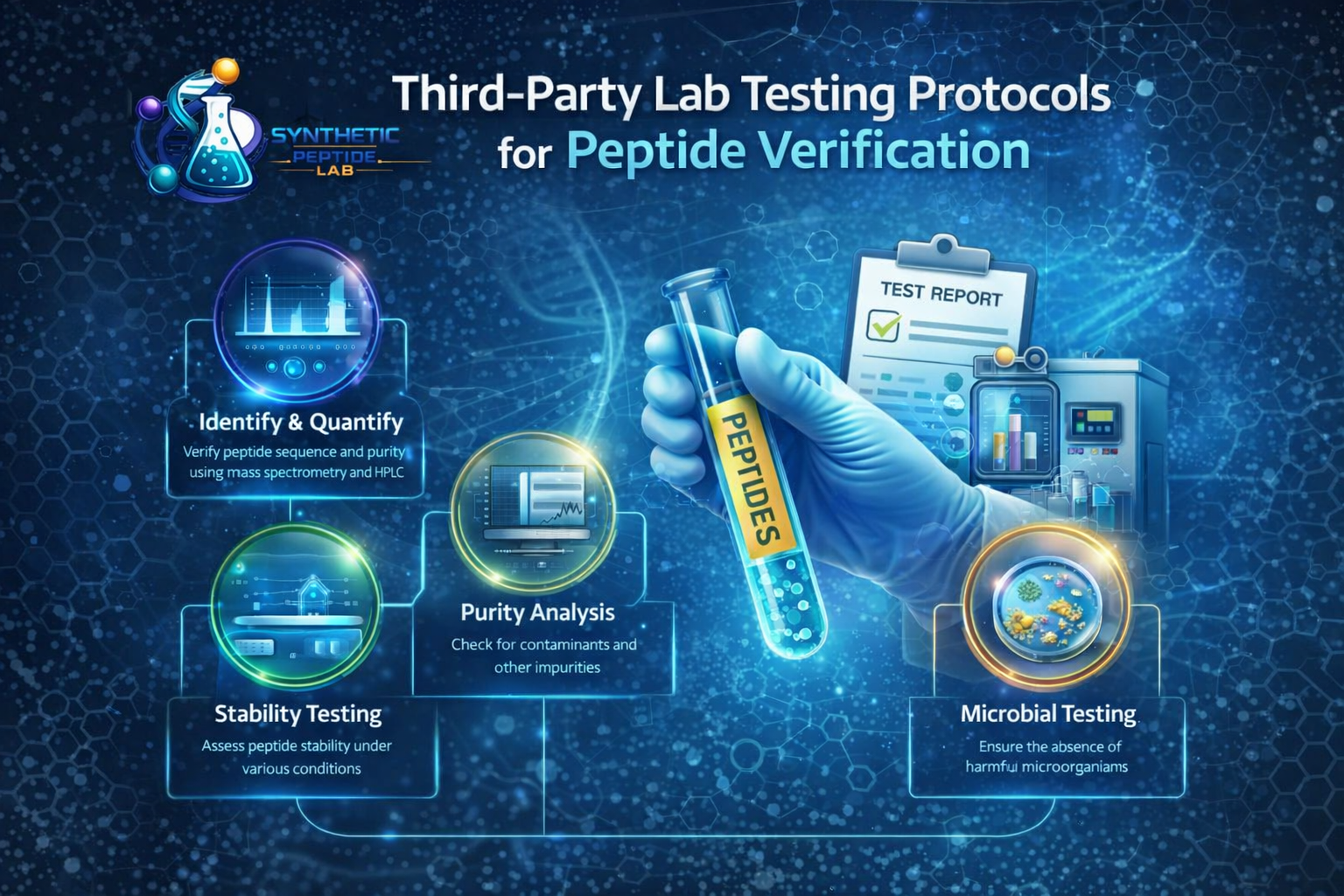
Third-Party Lab Testing Protocols for Peptide Verification
Third-party lab testing protocols for peptide verification are a critical component of modern peptide manufacturing and research supply chains. As peptide-based research expands in 2026 across metabolic, endocrine, neurological, and cellular biology fields, ensuring compound identity, purity, and structural integrity has become essential for scientific reliability.
Independent analytical testing provides unbiased confirmation that a peptide matches its claimed specifications—supporting reproducibility, safety in handling, and confidence in experimental outcomes.
At Synthetic Peptide Lab, third-party verification is integrated into quality assurance workflows to support high-standard research-grade peptide distribution.
What is Third-Party Peptide Testing?
Third-party testing refers to analysis performed by an independent laboratory not affiliated with the manufacturer or supplier. These labs specialize in advanced analytical chemistry and provide objective validation of peptide characteristics.
Primary Objectives
- Confirm peptide identity
- Verify purity levels
- Detect contaminants or impurities
- Validate molecular structure
- Ensure batch-to-batch consistency
This process helps eliminate bias and strengthens scientific trust.
Core Analytical Techniques Used in Peptide Verification
1. High-Performance Liquid Chromatography (HPLC)
HPLC is one of the most widely used methods for peptide purity analysis.
What It Measures:
- Purity percentage
- Impurity profile
- Compound consistency
Why It Matters:
HPLC separates peptide components, allowing researchers to assess whether the sample meets required purity standards for laboratory use.
2. Mass Spectrometry (MS)
Mass spectrometry confirms the exact molecular weight of a peptide.
What It Measures:
- Molecular mass accuracy
- Structural confirmation
- Fragmentation patterns
Why It Matters:
It ensures that the synthesized peptide matches its intended amino acid sequence.
3. Liquid Chromatography–Mass Spectrometry (LC-MS)
LC-MS combines separation and identification techniques for higher accuracy.
Applications:
- Structural validation
- Impurity identification
- High-resolution peptide mapping
This is considered a gold-standard method in peptide verification.
4. Amino Acid Analysis
This technique breaks down the peptide into its amino acid components.
What It Confirms:
- Sequence composition
- Ratio accuracy
- Structural integrity
5. Nuclear Magnetic Resonance (NMR) Spectroscopy
NMR provides structural insights at the atomic level.
Used For:
- Confirming molecular structure
- Identifying structural anomalies
- Advanced validation in complex peptides
Standard Third-Party Testing Protocol Workflow
A typical peptide verification protocol follows a structured process:
Step 1: Sample Collection
A representative batch sample is selected from production.
Step 2: Chain of Custody Documentation
Proper documentation ensures traceability and prevents contamination or substitution.
Step 3: Analytical Testing
Samples are sent to accredited third-party laboratories for multi-method analysis.
Step 4: Data Analysis
Results from HPLC, MS, and other techniques are compiled and reviewed.
Step 5: Certificate of Analysis (COA)
A formal COA is issued detailing:
- Purity percentage
- Molecular confirmation
- Testing methodology
- Batch identification
Key Parameters in Peptide Verification
1. Purity Level
High-quality research peptides typically require ≥95% purity or higher depending on application.
2. Identity Confirmation
Ensures the peptide sequence matches the intended molecular design.
3. Impurity Profiling
Detects:
- Truncated sequences
- Degradation products
- Synthesis byproducts
4. Stability Assessment
Evaluates how the peptide behaves under storage and handling conditions.
Importance of Third-Party Testing in Research
1. Scientific Reliability
Ensures experimental results are based on accurate and verified compounds.
2. Reproducibility
Allows researchers to replicate studies with consistent peptide quality.
3. Data Integrity
Reduces variability caused by impurities or incorrect formulations.
4. Regulatory Alignment
Supports compliance with research-grade chemical standards.
Common Issues Detected in Peptide Testing
Third-party labs often identify:
- Sequence truncation
- Incorrect amino acid incorporation
- Oxidation or degradation products
- Residual solvents
- Synthesis impurities
Identifying these issues is essential before peptides are used in research.
Role of Third-Party Testing in 2026 Peptide Research
In 2026, peptide research has become more complex due to:
- Multi-agonist metabolic peptides
- Long-acting hormone analogs
- Neuro-endocrine signaling compounds
- AI-driven biological modeling systems
This complexity increases the need for high-confidence analytical verification.
Benefits for Researchers
- Increased confidence in experimental outcomes
- Reduced risk of inconsistent results
- Stronger publication credibility
- Improved experimental reproducibility
- Better comparative study accuracy
Comparison: In-House vs Third-Party Testing
| Feature | In-House Testing | Third-Party Testing |
|---|---|---|
| Bias Risk | Higher | Minimal |
| Objectivity | Limited | High |
| Regulatory Acceptance | Moderate | High |
| Analytical Depth | Variable | Advanced |
| Research Trust Level | Moderate | Strong |
Third-party testing is widely considered the gold standard for peptide verification.
Storage and Handling Impact on Testing Results
Peptide quality can be influenced by:
- Temperature fluctuations
- Exposure to moisture
- Freeze-thaw cycles
- Light exposure
Proper handling ensures that lab results accurately reflect production quality.
Why Choose Synthetic Peptide Lab?
At Synthetic Peptide Lab, quality assurance is supported through structured verification practices.
Our Standards Include:
- Third-party analytical validation
- High-purity peptide sourcing
- Batch consistency controls
- Secure and stable packaging
- Full traceability documentation
This ensures reliability for advanced scientific research applications.
Important Notice
All peptides referenced are intended strictly for:
Research and laboratory use only.
They are not approved for human consumption or clinical use.
In an industry where purity is the ultimate currency, standardizing verification is essential. This guide outlines the third-party lab testing protocols for peptide verification in 2026, ensuring your research is backed by unassailable analytical data.
HPLC: High-Performance Liquid Chromatography
HPLC is the primary tool for determining peptide purity. A 2026 standard requires a minimum of 98% purity for analytical use. Our verified purity standards ensure that each batch is free from residual solvents and synthesis byproducts.
Mass Spectrometry (MS) and COA Interpretation
While HPLC confirms purity, Mass Spectrometry confirms identity. By measuring the molecular mass, MS ensures that the peptide sequence matches the intended design. Always demand a Certificate of Analysis (COA) that includes both HPLC and MS chromatograms before you order in bulk.
Conclusion
Third-party lab testing protocols for peptide verification are essential for ensuring accuracy, purity, and reliability in modern scientific research. Through advanced analytical methods such as HPLC, mass spectrometry, and LC-MS, researchers can confidently validate peptide identity and quality.
As peptide science continues to evolve in 2026, independent verification remains a cornerstone of trustworthy and reproducible research.
With high-quality, verified compounds from Synthetic Peptide Lab, researchers gain the confidence needed to explore complex biological systems with precision and scientific integrity.