

Achieving consistent results in biochemical research requires more than just high-purity compounds; it requires precision in preparation. In this 2026 technical guide, we break down the optimal reconstitution ratios for lyophilized peptides to ensure maximum stability and efficacy in your laboratory trials.
Understanding Lyophilized Peptide Solubility
Lyophilized peptides are supplied as a “cake” or powder to maintain long-term stability. The process of reconstitution—returning the peptide to a liquid state—is a critical step. Using the wrong diluent or ratio can lead to peptide aggregation or degradation. For high-stakes research, we recommend reviewing our analytical use standards before beginning.
The Standard Reconstitution Formula
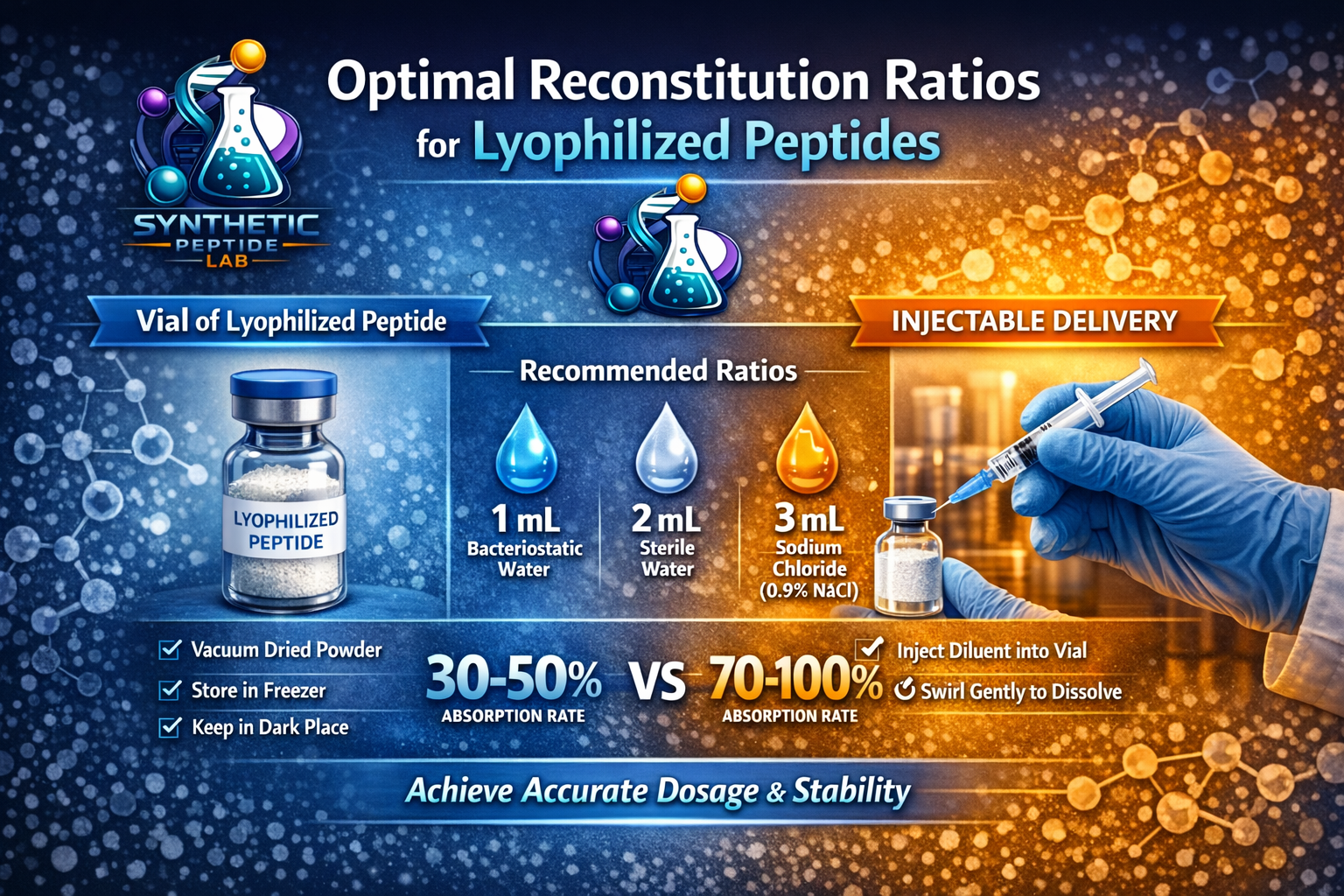
While specific sequences like BPC-157 or TB-500 may have unique requirements, the general rule for a 5mg vial is often 2ml to 3ml of Bacteriostatic Water. This creates a concentration that is easy to measure while maintaining osmotic balance.
- Bacteriostatic Water (0.9% Benzyl Alcohol): The gold standard for multi-use vials to prevent bacterial growth.
- Sterile Water: Best for single-use applications where immediate stability is prioritized over shelf life.
- Acetic Acid (0.1% to 1%): Required for basic peptides that do not dissolve in water alone.
Optimal reconstitution of lyophilized peptides depends on the specific mass of the peptide and the target research concentration. Because there is no universal solvent, the “optimal ratio” is functionally determined by the desired molarity or mg/mL required for a specific laboratory assay.
1. The Reconstitution Formula
To determine the exact volume of solvent required for a target concentration, use the standard laboratory equation:
$$\text{Volume to add (mL)} = \frac{\text{Mass in vial (mg)}}{\text{Desired Concentration (mg/mL)}}$$
- Example: To achieve a $5\text{ mg/mL}$ concentration from a $10\text{ mg}$ vial, add $2\text{ mL}$ of solvent.
- Common Research Targets: Standard stock solutions are often prepared at $1\text{–}10\text{ mg/mL}$, which can then be further diluted into working solutions for specific assays.
2. Solvent Selection Guide
The “ratio” of solvent to peptide is secondary to the type of solvent used, which is determined by the amino acid composition and net charge of the sequence.
| Peptide Category | Recommended Solvent | Technical Note |
| Highly Hydrophilic | Sterile Water (Non-bacteriostatic) | Ideal for sensitive peptides where additives might cause degradation. |
| Basic (Positively Charged) | 10% Acetic Acid | Used if water fails; helps dissolve peptides rich in Lys, Arg, or His. |
| Acidic (Negatively Charged) | 10% Ammonium Bicarbonate | Increases pH to aid dissolution of peptides rich in Asp or Glu. |
| Hydrophobic ($>50\%$ non-polar) | DMSO or DMF | Use the minimum volume of organic solvent first, then dilute with water/buffer. |
| Multi-dose Research | Bacteriostatic Water | Contains 0.9% benzyl alcohol to inhibit bacterial growth during repeated access. |
Optimal Reconstitution Ratios for Lyophilized Peptides
3. Critical Stability Protocols
Once reconstituted, peptides are significantly more vulnerable to degradation than in their lyophilized state.
- Avoid Vortexing: Mechanical shearing can damage the peptide structure; use gentle inversion or sonication to aid dissolution.
- Aliquot and Freeze: Repeated freeze-thaw cycles are deleterious. Reconstituted peptides should be divided into single-use aliquots and stored at $-20^{\circ}\text{C}$ or $-80^{\circ}\text{C}$.
- Oxidation Prevention: For peptides containing Cysteine (C), Methionine (M), or Tryptophan (W), use oxygen-free solvents to prevent rapid oxidation.
- Temperature Equilibrium: Always allow the lyophilized vial to reach room temperature in a desiccator before opening to prevent atmospheric moisture from condensing on the powder.
One thought on “Optimal Reconstitution Ratios for Lyophilized Peptides”